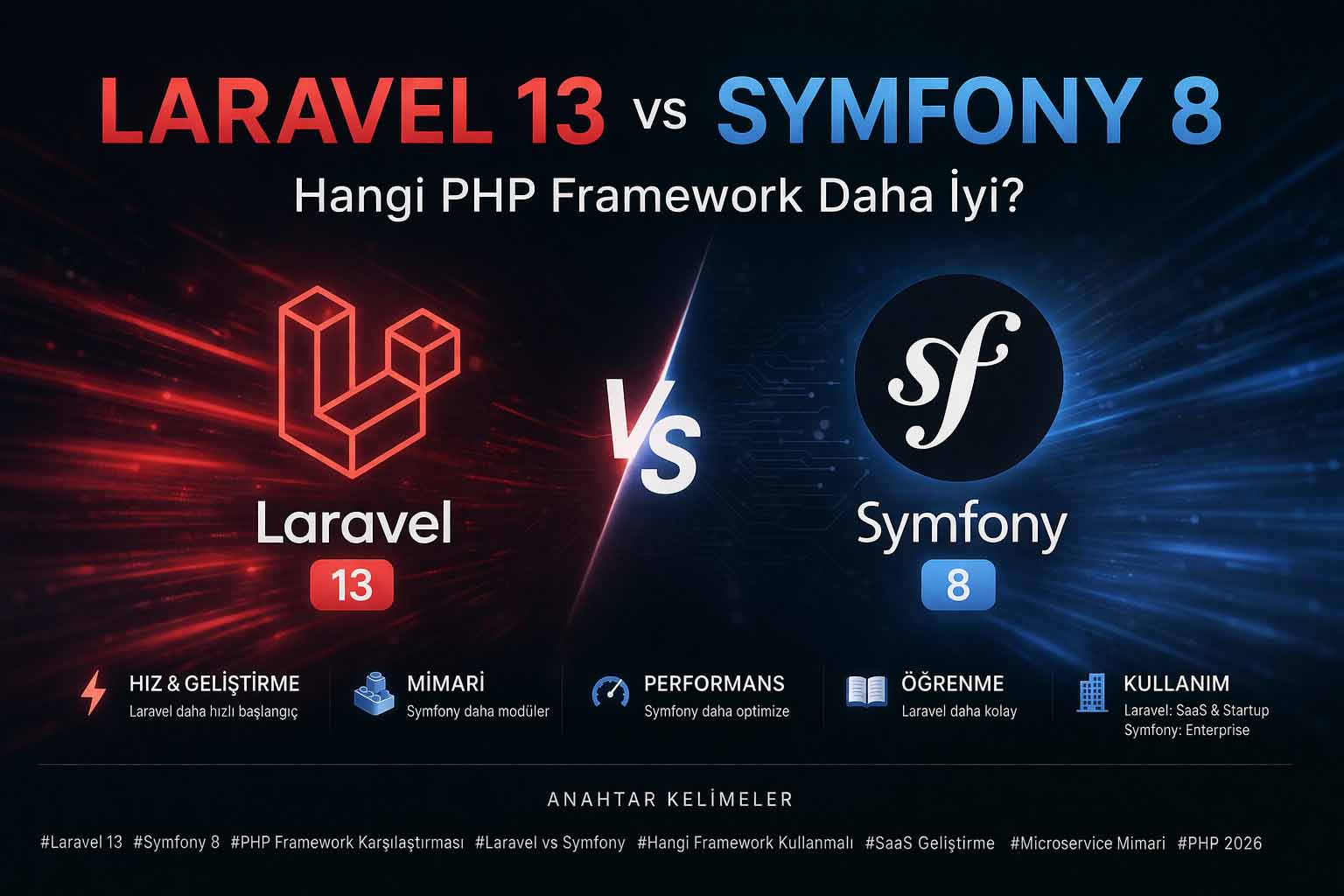
In the web development world, PHP remains one of the most powerful technologies, and the two most popular frameworks within this ecosystem are undoubtedly Laravel and Symfony .
So, as of 2026 , should you choose Laravel 13 or Symfony 8?
In this article, we will compare the two frameworks in detail in a way that everyone can understand.
🚀 What are Laravel and Symfony?
Laravel is a modern PHP framework that prioritizes developer experience (DX) and aims for rapid project development.
Symfony , on the other hand, is a more flexible, modular, and powerful framework designed for enterprise projects.
👉 In short:
- Laravel = rapid development
- Symfony = powerful architecture
🧩 Similarities Between Laravel and Symfony
The two frameworks actually have more in common than you might think:
- It is PHP based.
- It uses MVC architecture.
- ORM support is available.
- CLI tools are available (Artisan & Console)
- API development is supported.
- Cache, Queue, and Event systems are available.
📌 And here's another important piece of information: Laravel uses Symfony components in the background.
⚔️ Key Differences
🏗️ Architectural Approach
While Laravel offers mostly ready-made solutions, Symfony is completely modular.
- Laravel → "Ready-made package"
- Symfony → “Build your own system”
⚡ Development Speed
You can develop projects very quickly with Laravel.
Symfony, on the other hand, requires more configuration.
👉 Result:
- Laravel → Quick Start
- Symfony → more controlled development
🧠 Learning Curve
- Laravel is easy to learn.
- Symfony is more difficult to learn.
In Symfony in particular, Dependency Injection and the configuration system may seem complex at first.
🗄️ Database (ORM)
- Laravel → Eloquent (simpler usage)
- Symfony → Doctrine (a more professional structure)
👉 Eloquent is advantageous for simple projects.
👉 Doctrine is more controlled in large projects.
⚙️ Configuration
Laravel automatically handles many settings.
In Symfony, everything is under your control.
👉 Laravel: minimal settings
👉 Symfony: complete control
🚀 Performance
Symfony is generally more optimized and performs better.
Laravel, on the other hand, may consume slightly more resources due to the conveniences it offers.
🔐 Security
Both frameworks are secure.
However, Symfony offers a more detailed and flexible security structure.
💪 Strengths
🔥 Advantages of Laravel
- Rapid project development
- Extensive package ecosystem
- Easy learning
- Ideal for SaaS projects
- API development is very practical.
🔥 Symfony Advantages
- Suitable for corporate projects.
- Highly flexible architecture.
- Ideal for microservice architectures.
- Long-term stability
- Strong in big data and complex systems.
⚠️ Weaknesses
❌ Laravel
- Complexity can increase in large projects.
- "Magic" builds can make the debugging process more difficult.
- Performance may decrease in some scenarios.
❌ Symfony
- Difficult to learn
- Development time is longer.
- Too complicated for small projects.
🎯 Which Framework Should You Choose and When?
You should choose Laravel if:
- If you want to develop an MVP quickly
- If you are developing a SaaS project
- If you are developing an API + admin panel
- If it's a freelance or startup project
You should choose Symfony if:
- If you are developing a large-scale system
- If you are building a microservice architecture
- If there are very complex business rules
- Long-term enterprise project
🔥 Result
Laravel and Symfony aren't actually competitors; they're tools designed for different needs.
👉 If you want a fast and practical development process → Laravel
👉 If you want a strong and flexible architecture → Symfony
💡 Final Words
Choosing the right framework depends on the size of your project, your team, and your goals.
Remember:
The best framework is the one that best suits your project.